


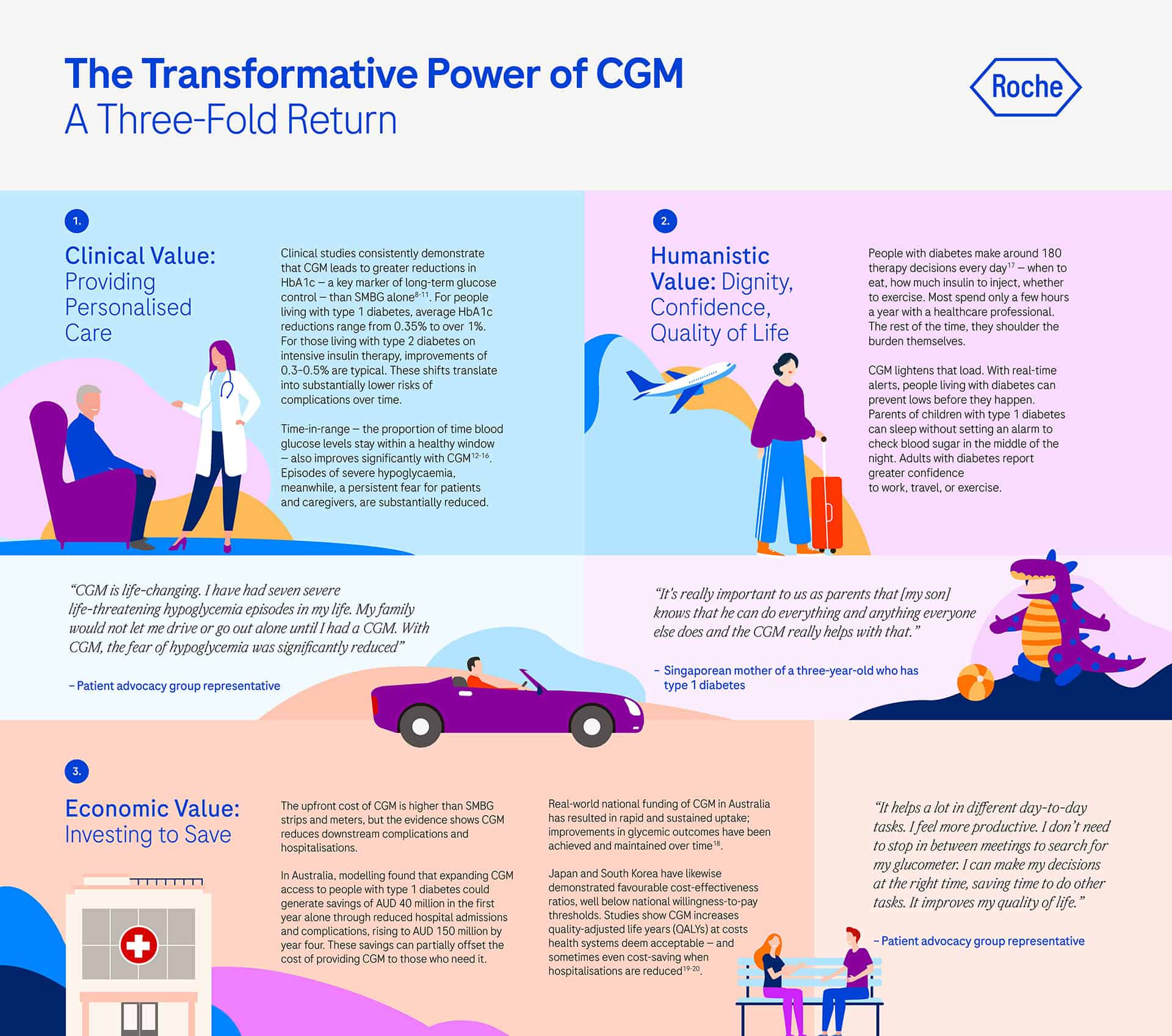
Diabetes prevalence rates are rising rapidly across Asia-Pacific, with immense human, clinical and economic costs. Our new white paper ‘Optimising Diabetes Management in Asia Pacific CGM: A Pathway to Personalised Care’ explains how Continuous Glucose Monitoring (CGM) offers a proven pathway to better outcomes — but only if health systems can ensure equitable access.
For someone living with diabetes, traditional blood glucose monitoring can be exhausting. Test strips and needles for self-monitoring of blood glucose (SMBG) can be expensive. The prospect of constant fingerpricks and device insertion feels daunting and invasive.
And the number of people experiencing these challenges is soaring. The Asia-Pacific region is now home to half of all people living with diabetes; the International Diabetes Federation (IDF) expects incidences of diabetes in Western Pacific, defined as including the ASEAN countries, China, Mongolia and Oceania, to reach 253.8 million by 20501.
This is not sustainable. The costs to healthcare systems are enormous; the APAC region is predicted to become the largest contributor to the global economic burden of diabetes by 2030, with an absolute cost of USD796.11 billion2
Across the Asia-Pacific region, suboptimal glycaemic control also creates a substantial clinical burden — averaging 1,120 Disability-Adjusted Life Years (DALYs) per 100,000 population. In Malaysia, hypoglycemia-related care alone costs an estimated RM 117.4 million (USD 30 million), accounting for 0.5% of the Ministry of Health’s budget3.
The majority of the total cost of diabetes, though, is borne by patients themselves — who incur substantial indirect costs from productivity losses and lifestyle changes4. People living with diabetes in Singapore report having to take unpaid leave or leaving jobs due to complications, while also facing high costs for healthy food and insurance5.
The chronic nature of the disease requires constant attention to glucose levels, diet, activity, and medication, often leading to psychological fatigue, reduced life satisfaction, and social limitations6. And the risks of poorly controlled diabetes are severe, including higher risks of blindness, kidney failure, amputations and cardiovascular disease.
Emerging complications, including cancer, liver disease, mental health issues, and infections, are also linked to diabetes7; the disease accounts for an average 14% of total mortality across the region.
Against this backdrop, CGM offers a vital tool to improve health outcomes. While SMBG is still the standard of care for monitoring glucose levels in many countries around the world, this method only provides snapshots of glucose at a single point in time.
CGM, by contrast, provides continuous, real-time information. Sensors worn under the skin track glucose levels every few minutes, allowing people with diabetes and their clinicians to spot dangerous trends, anticipate hypoglycaemic episodes and adjust treatment proactively.
But despite strong clinical and economic evidence, access remains highly uneven across the region.
| Established adopters like Japan have reimbursed CGM broadly, covering people with both type 1 and insulin-treated type 2 diabetes. | Expanding countries such as Australia, Singapore, South Korea and Taiwan, have extended reimbursement to type 1 diabetes, with pilots or partial coverage for priority type 2 groups. | Nascent territories — including India, Indonesia, Pakistan, the Philippines and Vietnam — still have limited or no public coverage, leaving most families to pay out of pocket. This inequity risks widening health disparities, with wealthier patients in urban areas able to access CGM while rural populations, lower-income households and minority communities are excluded. |
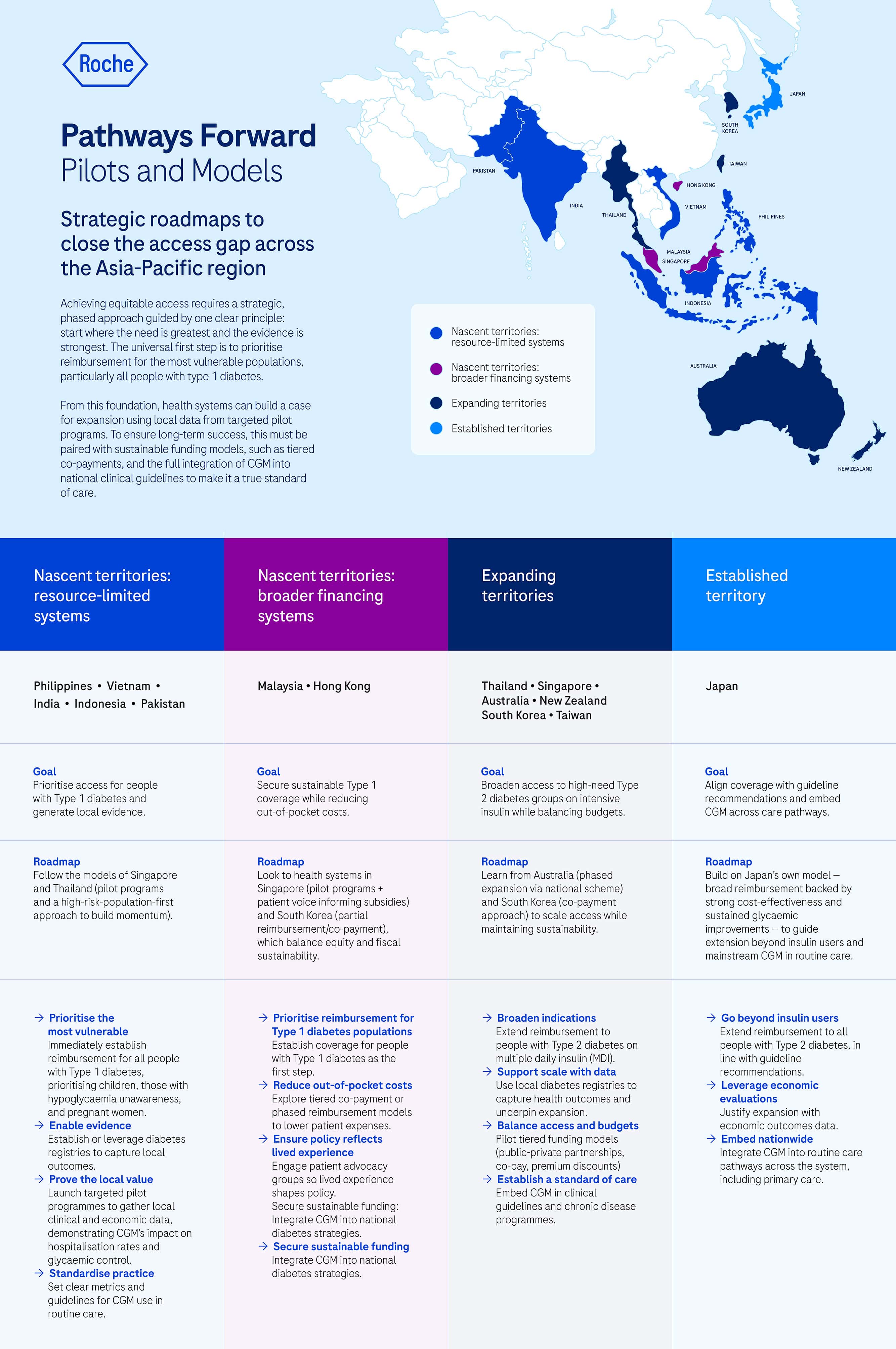
To translate these strategies into impact, we must draw on proven success models from across the region. Each of these models offer practical examples, which can be adapted to local health systems.
Singapore and Thailand have both used targeted pilots and a focus on high-risk groups to build the evidence case. Australia has scaled access in phases via a national programme; South Korea balances equity and budgets with co-payments. In Taiwan, CGM was piloted in a medical sandbox before expansion. Japan shows us what full integration looks like when cost-effectiveness is clear.
CGM reimbursement in Australia began in 2017 for children and young adults living with type 1 diabetes under 21, later expanding to cover all people with type 1 diabetes. Access is provided through the National Diabetes Services Scheme (NDSS), which subsidises CGM devices.
In 2022, the government committed AUD 273.1 million to extend those subsidies to all people with type 1 diabetes, with a patient co-payment capped at AUD 32.50 per month for those over 21.
South Korea introduced CGM reimbursement through the National Health Insurance Service (NHIS) with partial coverage; 70% of device costs are reimbursed for people with type 1 diabetes. Over time, the NHIS expanded eligibility to include pregnant women with type 2 diabetes (type 2 diabetes) on insulin therapy.
Taiwan adopted CGM reimbursement in 2017 under its National Health Insurance (NHI) framework under a medical sandbox scheme to pilot innovative technologies, initially covering people with type 1 diabetes, neonatal diabetes, and post-pancreatectomy diabetes. The policy was later expanded to include gestational diabetes on insulin, supported by an additional NT$2.5 million annual budget.
Reimbursement is limited to twice per year, with a three-month minimum interval, and reassessment every six months.
In Singapore, CGM reimbursement began with subsidies for people with type 1 diabetes. The Agency for Care Effectiveness (ACE), the national HTA body, approved public subsidies after incorporating both clinical evidence and patient voices via community surveys. Before reimbursement, public hospitals had piloted CGM programmes using grants, generating local evidence that supported the decision.
Today, subsidies reduce out-of-pocket expenses for type 1 diabetes patients, although coverage for other people living with diabetes is still under consideration.
Thailand took a phased, high-risk-group-first approach. Reimbursement initially covered four priority type 1 diabetes groups: children under 7, pregnant women, those with uncontrolled HbA1c, and patients with frequent severe hypoglycaemia.
Following a positive health technology assessment, coverage expanded to all type 1 diabetes patients with clinical indications. Funding is provided through the National Health Security Office (NHSO), and adoption was supported by the Thailand Type 1 Diabetes Network and registry, which provided real-world outcome data.
Japan was among the earliest adopters of CGM, reimbursing under its national health insurance system for both type 1 diabetes and insulin-treated type 2 diabetes. Reimbursement covers real-time and intermittent scanning CGM, contributing to high uptake and sustained improvements in glycaemic control.Economic evaluations showed strong cost-effectiveness, with an ICER of approximately JPY 4.4 million (USD 41,000) per QALY gained, well within national thresholds19.
These health systems provide varied blueprints for success — but no single stakeholder can drive equitable CGM access alone. Success depends on collaboration between diverse stakeholders.
We call on policymakers to create reimbursement frameworks which expand access to all those who experience the biggest challenges maintaining glycemic control. Health technology assessment (HTA) agencies play a vital role too, evaluating value including often-overlooked humanistic outcomes.
Clinicians and professional societies must incorporate CGM into treatment guidelines and educate peers. Patient advocacy groups, meanwhile, can share lived experiences to inform decision-making, ensuring health policy reflects the true needs of patients. Industry partners can support evidence generation, training, and innovative funding models.
When we work together, with a tailored roadmap for each health system, progress can be swift.
The Asia-Pacific diabetes crisis has never been more urgent. If we do not take action, we stand to lose millions of lives.
But solutions are within reach. We can turn the tide on diabetes — if we seize the opportunity. CGM is a vital tool to help us get there. By working together to provide equitable access across the Asia-Pacific region, we can improve outcomes, reduce costs, and give people living with diabetes more confidence and quality of life.
For the many millions of people who will rise long before dawn to check their levels tomorrow, that cannot come soon enough.
To learn more about the clinical, economic and humanistic benefits of CGM and the models for reimbursement, access and download the white paper here
Share
Link copied