

By Diagram insights
Published: 2026-11-04 | 7 min read I Region: Asia-Pacific, New Zealand
Topics: Alzheimer’s disease, dementia, diagnostics
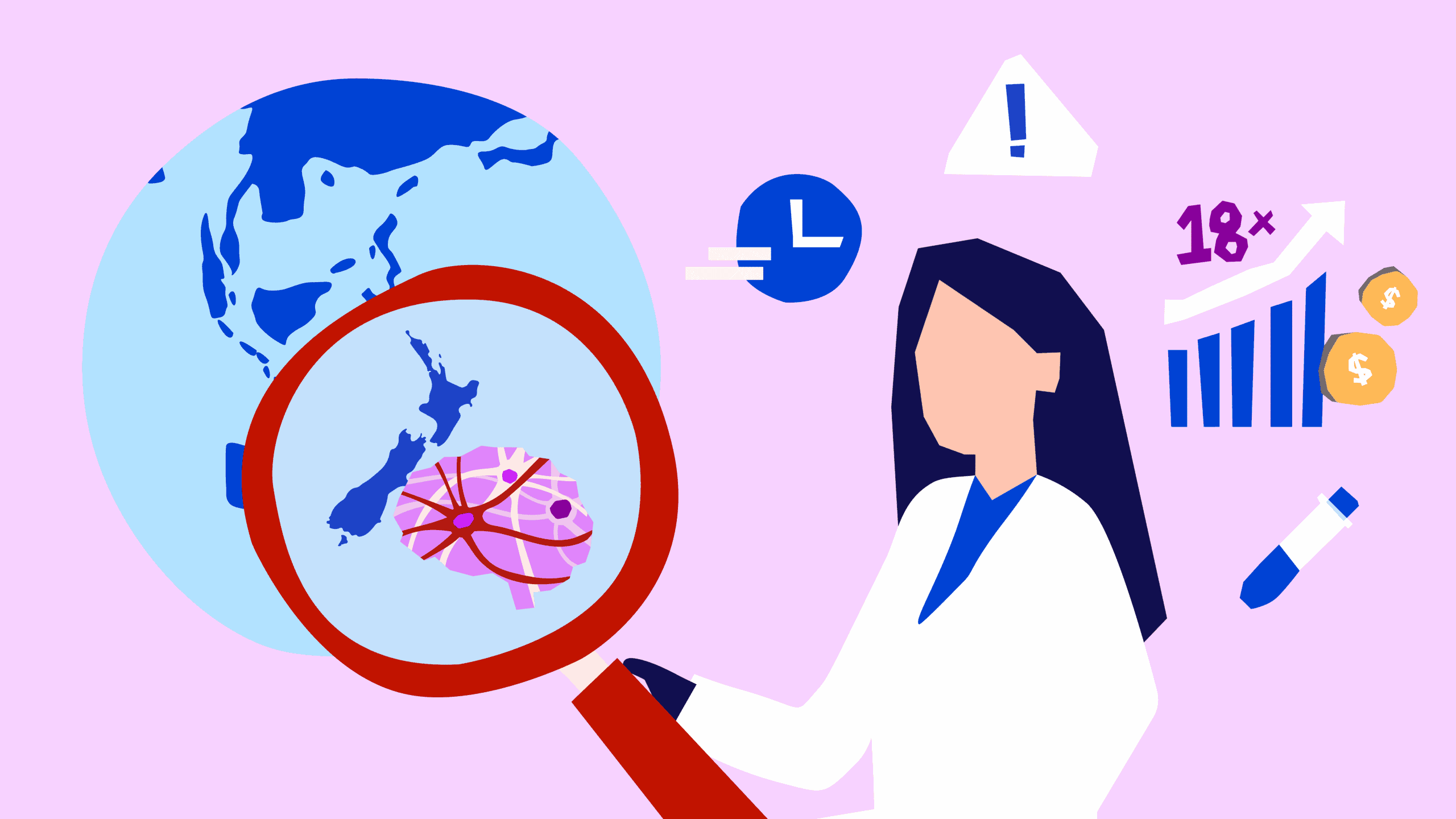
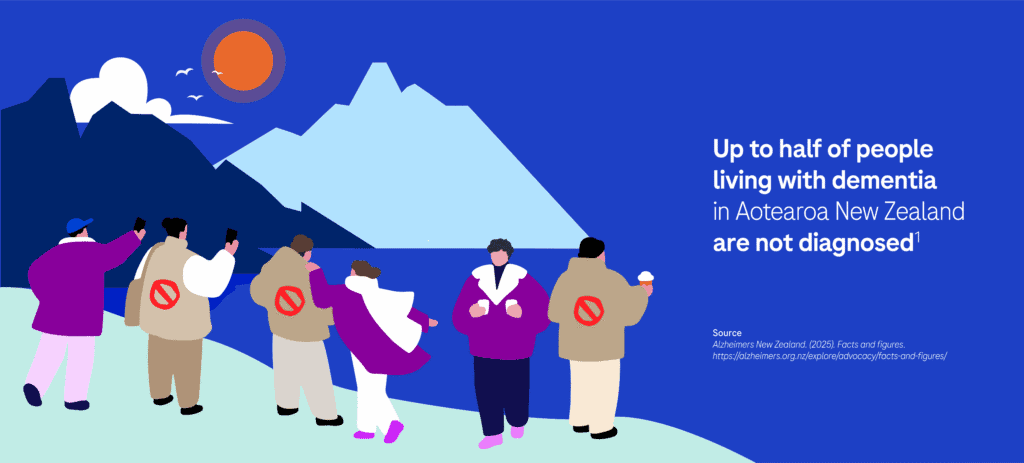
No disease-modifying treatment for Alzheimer’s disease is currently available in Aotearoa New Zealand, and up to half of people living with dementia – known in te reo Māori as mate wareware – are not diagnosed1. A social return on investment analysis estimates that a more accessible diagnostic test could generate NZ$18.21 in social value for every NZ$1 spent5.
New Zealand’s population is ageing. In 2025, an estimated 83,000 people were living with dementia mate wareware – and projections indicate around 170,000 will be living with the condition by 2050.1 Alzheimer’s disease accounts for 60-70% of cases.2
The growing disease burden creates an equally costly economic burden; by 2050, the annual economic cost of dementia in New Zealand is projected to reach approximately $10.65 billion in inflation-adjusted 2050 dollars.1
But this burden doesn’t fall evenly across the population. Māori, Pacific and Asian peoples are experiencing more rapid growth in prevalence compared with Pākehā (New Zealanders of European descent);1 the risk of dementia is 45% – 80% higher for Māori and Pacific peoples in both young and late-onset dementia, due to the higher rates of risk factors in these ethnic groups.3
In New Zealand, there is no single pathway to an Alzheimer’s disease diagnosis, and dementia subtypes are not always consistently differentiated or communicated.5
Alzheimer’s disease is usually diagnosed clinically, through history, cognitive testing, blood and urine tests and sometimes a CT scan.6 Confirming the underlying pathology requires cerebrospinal fluid (CSF) from a lumbar puncture, or an amyloid PET (positron emission tomography) scan.7
CSF testing and Amyloid PET are not widely available.6 People often complete a series of tests over time, see multiple healthcare professionals and wait years for an answer, paying for appointments along the way.5
This can leave people and whānau (immediate or extended family) uncertain about the cause of symptoms, likely progression and appropriate management.5
Blood-based biomarker (BBBM) testing has the potential to bridge this diagnostic gap for the first time, supporting more accessible and timely pathways to greater diagnostic certainty. These tests can detect amyloid pathology associated with Alzheimer’s disease and, when considered alongside a person’s signs and symptoms, can support a more certain diagnosis at an earlier stage.5
BBBM testing accuracy is high.8 In a study of 1,767 people with cognitive symptoms across five European cohorts, a fully automated blood test for p-tau217, a form of protein found at raised levels in Alzheimer’s disease, reached 92% to 94% accuracy in both primary care and specialist memory clinics.8
In a Swedish study of 1,213 people being assessed for neurological changes, primary care clinicians identified Alzheimer’s disease correctly in 61% of cases after clinical examination, cognitive testing and a CT scan. Dementia specialists did so in 73% of cases.9
A blood test, meanwhile, correctly identified the disease in 88-92% of cases.10 A test of similar accuracy – available in primary care – would give a GP at the first appointment the level of certainty that currently requires a specialist referral.
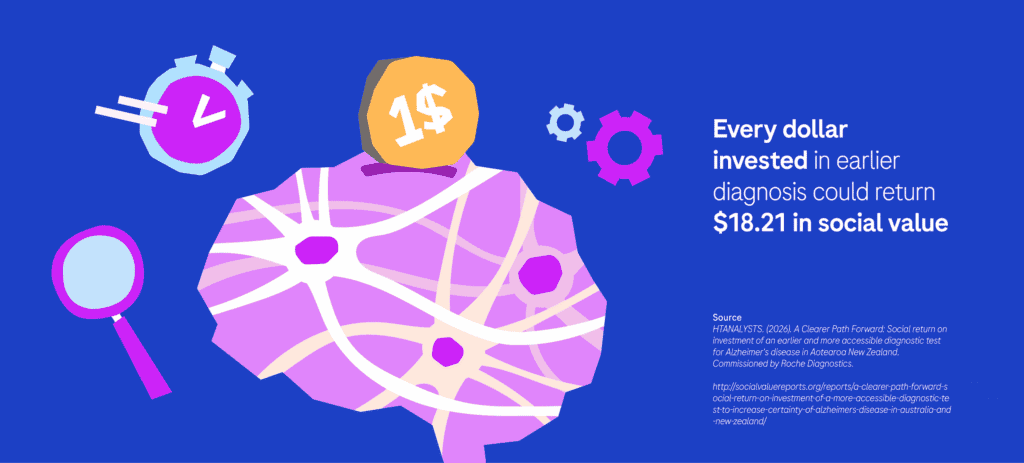
Investment in earlier diagnosis with BBBMs delivers a considerable return. A Social Return on Investment (SROI) analysis of earlier Alzheimer’s diagnosis in New Zealand shows that improving access to earlier, more certain diagnosis could deliver significant value for people, whānau and society: for every NZ$1 invested in a more accessible diagnostic test for Alzheimer’s disease, the model estimates NZ$18.21 in wider social value.5
Benefits include maintaining independence, reducing distress, enabling earlier legal and financial planning, and connecting people with appropriate care and support.5
For people living with Alzheimer’s disease and their families, earlier diagnostic certainty gives them more opportunity to act, to plan, access support, maintain independence and make the most of meaningful time together.5
The value of these benefits is directly quantifiable. Every $1 invested could generate $18.21 in social value.5
An investment of about NZ$5.65 million to test 12,935 people annually could, the model estimates, generate around NZ$102.87 million in social and economic value. The model covers around 9,055 people with likely Alzheimer’s disease, 5,146 partners and 19,015 children.5
None of this value depends on beginning treatment.5 It comes from knowledge. The value of greater diagnostic certainty extends far beyond the individual, with potential social, emotional and economic benefits for partners, children and whānau through relationships, well-being, caring responsibilities and participation in work.5
Greater diagnostic certainty can’t, however, deliver its full potential in isolation. It needs to be accompanied by accessible information, culturally appropriate care and consistent post-diagnosis support.5
The research identified three priorities for implementing diagnostic services for Alzheimer’s disease in New Zealand.5
The first is supporting people to make brain-healthy choices, and seek a diagnosis. Almost half of dementia cases in New Zealand (47.7%) are potentially preventable by addressing modifiable risk factors across the course of life, with higher potential again for Māori and Pacific peoples.4
People interviewed for the research described fears about losing their driver’s licence, having to leave work and being seen differently by others.5 Some of those fears rest on misinformation: a diagnosis of Alzheimer’s disease does not automatically cost someone their licence.5 International evidence points the same way: a systematic review and meta-analysis of 34 studies found that around 37% of adults aged 40 and over said they would not accept dementia screening.11
The second is tailoring tests and supporting information to meet the needs of different populations. Diagnosis currently relies on tests of how a person’s brain is functioning, and test format, language and cultural assumptions all affect how accurately someone can complete one. Interview participants whose first language was not English described how difficult that becomes when a person is already struggling with cognitive change, and how little supporting information exists in their language.5
Because Māori and Pacific peoples are often diagnosed younger,1 research calls for a shift in how the health system and the wider public think about the age at which dementia develops.5
The final recommendation is embedding consistent access to culturally appropriate services wherever people live. Standard care guidelines already include referral to support services after a diagnosis, but people interviewed did not consistently experience it. Several described working out programmes, care homes and community services on their own, and one said no support or information arrived at all.5
A Government Health Select Committee inquiry into aged care capacity found that community support helps people remain independent in their own homes.12
Earlier diagnosis does not slow Alzheimer’s disease on its own. It gives people time to plan, support that arrives sooner, and a clearer understanding of what is happening to them and their whānau.
The full SROI analysis, A Clearer Path Forward, sets out the model, valuation method and interviews with people living with Alzheimer’s disease and their whānau in detail. Read the report here: [DOWNLOAD THE REPORT →] http://socialvaluereports.org/reports/a-clearer-path-forward-social-return-on-investment-of-a-more-accessible-diagnostic-test-to-increase-certainty-of-alzheimers-disease-in-australia-and-new-zealand/
Footnote: Mate wareware is the preferred Te Reo Māori word for dementia. There are a range of terms that can be used by different communities which reflect the range of experiences and views of dementia.
Share
Link copied