


What if diabetes didn’t take such a heavy emotional toll on the many millions of people who live with it?
Managing diabetes is a demanding, stressful, full-time job. Someone living with diabetes will typically make up to 180 treatment decisions per day1, and globally, three in four people living with diabetes say it impacts on their mental wellbeing2.
Roche surveyed 4,326 people living with diabetes across 22 economies to understand how diabetes is perceived, how people living with diabetes manage their condition, and what challenges these individuals face in their day-to-day lives.
Based on these insights, we’ve identified key opportunities in four Asia-Pacific economies for Continuous Glucose Monitoring (CGM) to empower patients with the confidence to better manage their condition and ease the emotional burden.
Current diabetes management doesn’t always deliver the control people may need. People with diabetes are looking for smarter technology and foresight into how their glucose levels are shifting.
In Australia, a triple threat in diabetes care risks overwhelming health systems: rising prevalence, increasing clinical complexity, and a mounting mental health crisis. Prevalence for type 2 diabetes has tripled since 1990 to almost 1.5 million people4 — and the emotional toll has grown with it.
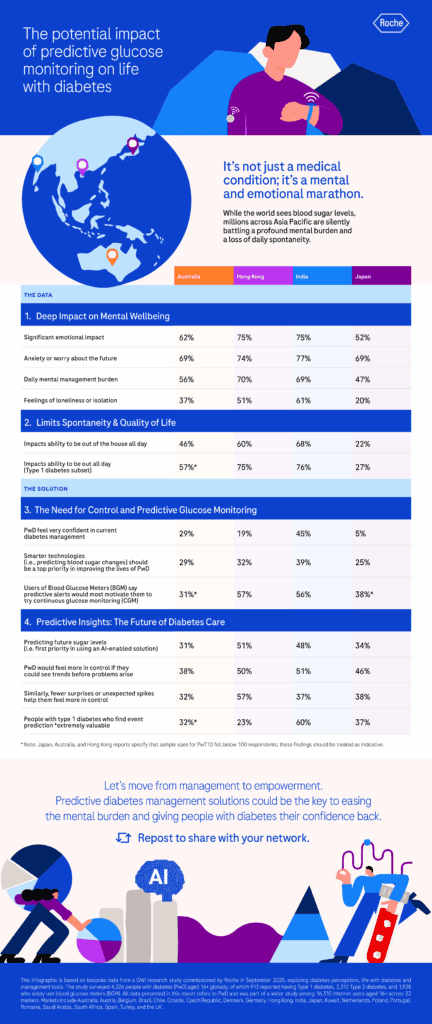
62% of people living with diabetes in Australia (and 75% of people living with insulin-treated diabetes) agree or strongly agree that living with diabetes significantly impacts their emotional wellbeing5. Nearly 50% of Australians living with diabetes experience a mental health challenge annually6. One in four people with Type 1 diabetes and one in five with insulin-treated Type 2 diabetes experience severe distress7.
68% of people living with diabetes in Australia say a tool that predicts hypoglycaemia or hyperglycaemia before it occurs would be valuable, and 38% say that seeing trends before they turn into problems would help them feel more in control of their condition in everyday life.5
By providing the visibility needed to predict and prevent overnight lows, CGM with predictive technology mitigates uncertainty — shifting people from reactive management to proactive control and helping them achieve better health outcomes.
One in seven adults living with diabetes globally are in India8. 77 million people are living with Type 2 diabetes; a further 25 million people are prediabetic8.
The scale of the public health challenge comes with a vast psychological cost. India reports some of the highest levels of daily mental burden (69%) and future-oriented anxiety (77%) associated with diabetes5. 75% of people surveyed in India say their condition significantly impacts their emotional wellbeing5.
Notably, 83% of those surveyed are willing to discuss these challenges with family and friends, and 82% with their healthcare professional5 — but this willingness to talk doesn’t always translate into acceptance. 61% of people living with diabetes in India say they sometimes feel lonely or isolated because of their condition.
Even more — 63% — say diabetes negatively affects them feeling accepted in social and professional circles5. More than two in five people (42%) say public awareness of diabetes should be top priority to improve their lives, while 29% want better understanding at work above all other priorities5.
83% of people living with diabetes in India would value a tool that predicts hypoglycaemia or hyperglycaemia before it occurs. By making effective self-management visible and more intuitive, predictive technology has the potential to help break the cycle of anxiety — and give people greater confidence in managing daily life.
The 700,000 people living with diabetes in Hong Kong9 experience extreme pressure balancing their condition with the demands of urban life. They worry about ordinary moments in their daily routines; 73% of those surveyed say it negatively impacts their ability to take care of children and household chores5. Almost the same number — 74% — agree or strongly agree that living with diabetes significantly impacts their emotional wellbeing5.
Only 19% feel very confident in how they currently manage their condition. More than half — 55% — say their diabetes negatively impacts their confidence that the day ahead will go as planned, 54% say diabetes negatively impacts their ability to deal with being stuck in traffic or in a meeting that runs over, and 60% say diabetes negatively impacts their ability to be out of the house all day long5.
The demand for predictive solutions is correspondingly high–86% of people living with diabetes in Hong Kong say a tool that predicts hypoglycaemia or hyperglycaemia before it occurs would be valuable5.
In Japan — where almost 9 million people are living with diabetes10 — confidence in daily management is strikingly low. The burden is often carried alone. Just 5% of those surveyed feel very confident in managing their diabetes, compared with 29% in Australia.5 And while more than eight in 10 people surveyed in India feel able to talk about the emotional challenges of living with diabetes, only 36% of those in Japan are similarly open with family and friends.5
27%, meanwhile, say diabetes prevents them from getting a good night’s sleep.5 Clinical research in Japan links increased glycaemic variability directly to sleep latency — the time taken to fall asleep — and elevated stress among workers.11 Poor sleep can increase anxiety; anxiety contributes to reduced glycaemic control12.
This cycle is difficult to break without predictive insights. And demand for those insights is growing: half of people living with diabetes in Japan would value predictive CGM to manage their condition, rising to 59% among those treated with insulin.5
Across all four economies, the data points in the same direction. Despite the differences in how diabetes is experienced — Australia’s mental health crisis, stigma in India, the urban pressure of Hong Kong, the sleep-stress cycle in Japan — people living with diabetes share a common need: to know what’s coming before it arrives.
AI-enabled predictive CGM devices can meet that need. When people living with diabetes are able to forecast where blood sugar levels are trending in the next 30 minutes, two hours and even overnight 13, they can move from a reactive approach to take control and proactively manage their condition14.
The outcome is true patient-inclusivity: empowering people living with diabetes with accurate information and inclusive care. It’s how we connect diagnostic insights with therapeutic solutions — enabling earlier detection, smarter decisions, and personalised treatment to finally lift the emotional weight off their shoulders.
Share
Link copied